- March 2001 Microbiology "Do antigermicides work?"(with video)
Hydrogen is a colourless, odourless, tasteless, flammable and non-toxic gas at atmospheric temperatures and pressures. It is the lightest gas known, being only some seven one hundredths as heavy as air. Hydrogen is present in the atmosphere, occurring in concentrations of only about 0.01 per cent by volume at lower altitudes. Its’ international symbol is (H2), its’ molecular weight is 2.016
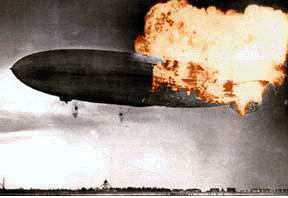
Hydrogen burns in air with a pale blue, almost invisible flame. Many will be aware of the airship disaster when the Hindenburg caught fire in 1937 (see photo). Fewer will be aware that the biggest user of hydrogen today is NASA who use liquid hydrogen as fuel for space craft. Hydrogen produces no pollution and many scientists and engineers are working to create cheap and plentiful supplies of hydrogen for energy.
Objective
My objective is to prove that hydrogen is flammable and that it
is lighter than air. I hypothesise that I can collect hydrogen
in a balloon as it will rise out of the bottle. I should also
be able to light the gas at the bottles’ opening.
Experiment
Safety Note
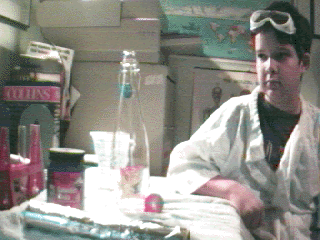
The first step is to ensure that you have protective gear including
glasses and a laboratory coat. Gloves can also be worn. Should
be done under adult supervision
* caustic soda is highly corrosive and can burn skin
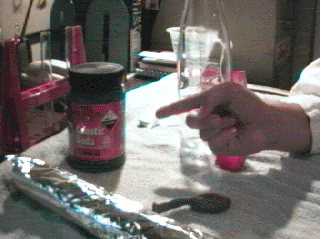
The requirements for this experiment include:
• Test tube or dry glass bottle
• Caustic soda * (sodium hydroxide- H SO-4 I think!)
• Aluminium foil (Al)
• Funnel
• Small spoon
• Hot water (H-2-O)
•Container for water
• Balloon
Experiment method using bottle
:
1. Cut aluminium foil into 15 small bits (stamp size)
2. Place foil in bottle
3. Add 3 teaspoon of caustic soda
4. Add about 500ml of hot water to bottle
5. Rotate bottle & cover hole immediately with balloon to collect
gas which will form. When some gas has formed, remove and tie
balloon
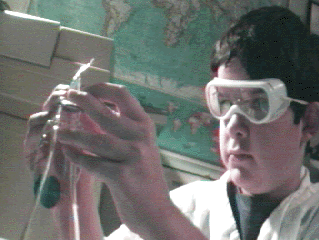
6. When removing balloon cover hole with foil, wait 2 minutes
and then poke hole in foil just as a lighted match is placed over
top.
Observations:
When I put the water in with the caustic soda and aluminium they
reacted and started to make hydrogen gas. When I put the balloon
over the bottle because the gas is so light, it started to fill
the balloon. I hypothesise that the aluminium was oxidised (eaten
away) by the caustic soda and the water (H-2-O) then reacted with
it to create hydrogen.
Then when I put the aluminium over the hole, and put a small hole
through it, the hydrogen came out. Because it is flammable a flame
started when I lit a match over it. In one experiment, a small
explosion occurred.